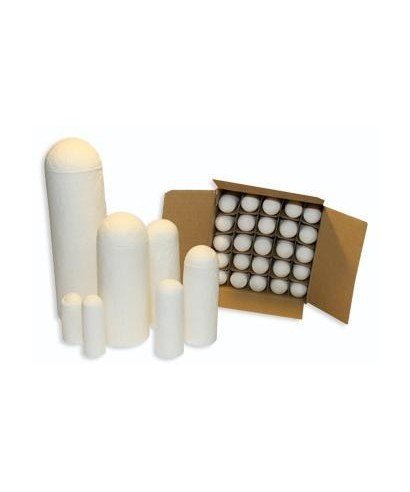
The cellulose extraction cartridges, designed for use in Soxhlet extractors, Tecator or similar devices, are crucial elements in the process of extracting soluble compounds from solid samples. These cartridges function as containers that hold the sample during the continuous extraction process, where the solvent is repeatedly circulated through the sample to dissolve the desired compounds.
The structure of the cartridge is critical, as it usually consists of a cylinder made of a porous material, such as cellulose or filter paper. This feature allows the solvent to circulate while keeping the solid particles contained, preventing them from mixing and ensuring that only soluble compounds are carried away. In this way, the cartridge guarantees an efficient separation between the extracted solutes and the residual solids.
In short, the extraction cartridge:
? Ensures compact containment of the solid sample.
? Facilitates the passage of the solvent without entrainment of solid material.
? Improves the efficiency of the extraction process by adequately separating the extracted compounds.
This component is essential for optimal extractor performance, as it promotes a clean and efficient extraction process. Each cartridge has an approximate capacity ideal for small sample quantities, and is used in contexts where solvent efficiency and speed of extraction are priorities.
The 41?123 mm cartridge holds approximately 10 grams or more of solid sample.
This size is ideal for large-scale extractions, such as in compound extraction studies of plants, foods, or natural products, where a considerable amount of sample needs to be extracted. It is suitable for research work that requires a large amount of extracted material and where large volumes of solvent are available.
Due to its large size, it requires a lot of solvent and circulation time to complete the extraction, which can make the process more costly and time-consuming. It is less efficient for small sample quantities.






![ANTI D TITRE – [Serum]](https://app.analysisafrica.com/backend/uploads/tests/images/1754385122_6891cae238432.jpg)












 No products in the cart.