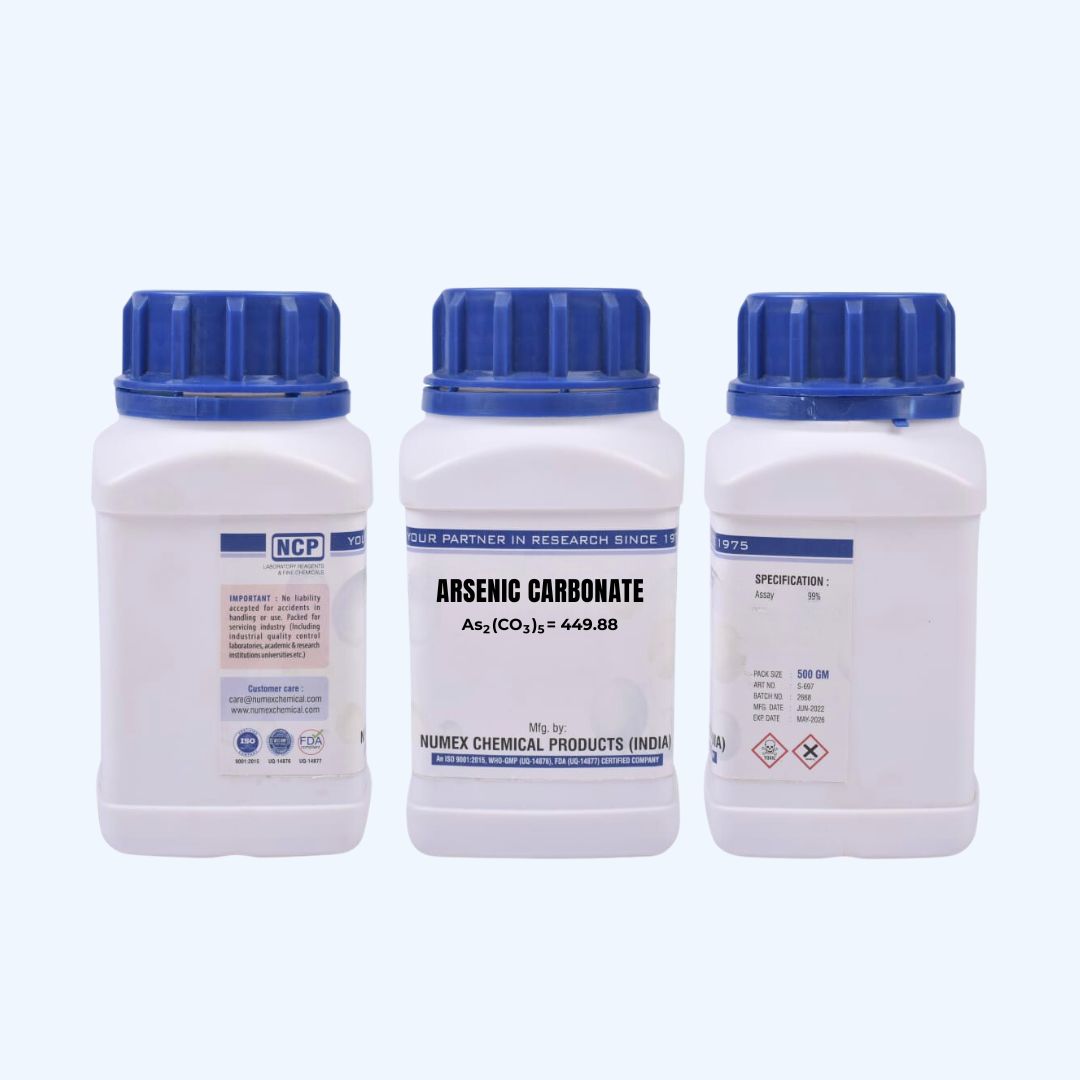
Arsenic Carbonate (500 gm) is a specialized chemical compound essential in laboratory research. It serves multiple purposes in chemical analysis, including its use as a reagent in the synthesis of various compounds. This high-quality chemical ensures precise results and is suitable for a wide range of experiments. Its stable nature makes it a trusted choice for researchers and scientists, providing the necessary accuracy and consistency for scientific experimentation.
Key Features
High-purity arsenic carbonate ideal for laboratory applications.
500 gm packaging for long-term use and convenience.
Reliable and consistent for accurate experimental results.
Essential for research and chemical analysis in scientific fields.
Suitable for a wide range of chemical synthesis processes.
Precautions
Handle with care as arsenic compounds can be toxic if inhaled or ingested.
Wear appropriate personal protective equipment (PPE) such as gloves and goggles.
Store in a cool, dry place away from incompatible materials like acids.
Ensure proper ventilation in the laboratory during use.
Dispose of according to local environmental regulations and safety standards.
Frequently Asked Questions (FAQs)
Question: What is the purity of Arsenic Carbonate (500 gm)?
Answer: Arsenic Carbonate is of high purity, making it suitable for precise laboratory experiments and analysis.
Question: How should Arsenic Carbonate be stored?
Answer: It should be stored in a cool, dry place, away from acids and incompatible materials to prevent reactions.
Question: Is Arsenic Carbonate dangerous?
Answer: Yes, arsenic compounds can be toxic. It is crucial to handle them with care and follow safety precautions.
Question: Can Arsenic Carbonate be used in all types of laboratory experiments?
Answer: It is suitable for a wide range of chemical analyses and research, but always ensure it is appropriate for your specific experiment.
Question: What safety measures should be taken when handling Arsenic Carbonate?
Answer: Always wear protective gear such as gloves, goggles, and ensure proper ventilation in the lab to avoid exposure.










![ANTI D TITRE – [Serum]](https://app.analysisafrica.com/backend/uploads/tests/images/1754385122_6891cae238432.jpg)







 No products in the cart.