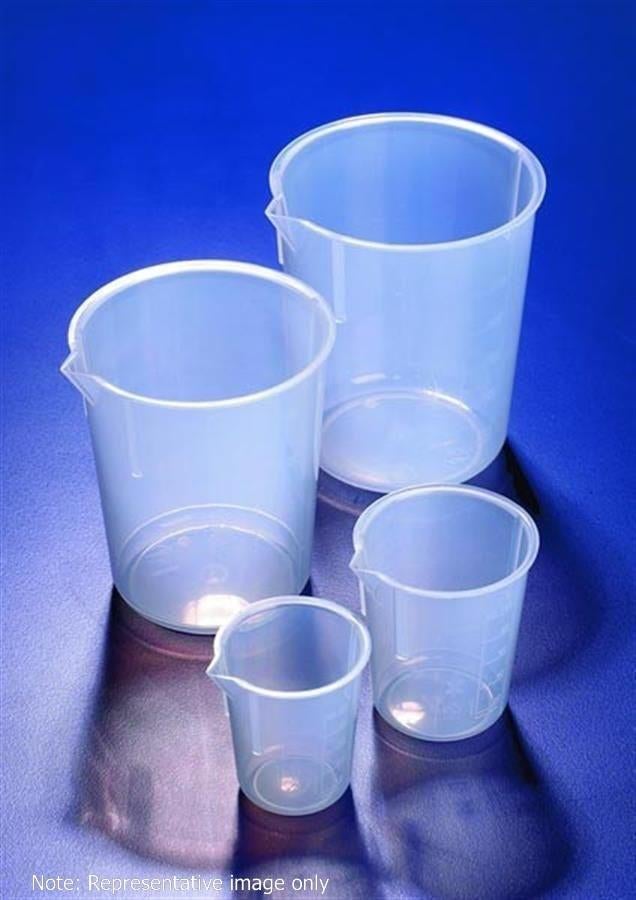
Tapered stacking style - space saving and easy to handleHigh clarity Polypropylene - autoclavable at 121?C with good chemical resistance Durable and economical with clear moulded, easy to read graduations Precise non drip pouring spouts - safe and easy to use Comply to ISO7056 Specifications
Item Code
Graduation ml
Capacity ml
Rim diameter mm
Height mm
Pack quantity
BPM0025P
5
25
41.5
51
10
BPM0050P
10
50
50.5
61
10
BPM0100P
20
100
61.5
73
10
BPM0250P
50
250
80.5
96
10
BPM0400P
50
400
92.5
111
10
BPM0500P
50
500
102.5
121
10
BPM0600P
50
600
104.0
126
5
BPM1000P
100
1000
120.0
148
5
BPM2000P
200
2000
163.0
188
1
Cleaning, autoclaving and maintenance plasticware Azlon??plasticware is reusable but how long it lasts depends on how well you treat it! Follow these guidelines to keep your Azlon??plasticware in the best possible condition.
1. What chemicals are coming into contact with your plasticware?
Chemicals can adversely affect the performance of plasticware even resulting in damage. Make sure you use the most suitable polymer for the chemical. For example, if you are working with Acetone you should always choose LDPE over HDPE as products made of HDPE are likely to incur immediate damage. Why not consult the plastic technical guide if you are unsure.
2. How do you wash and clean your Azlon??plasticware?
Azlon??plasticware should be cleaned in warm water with Lipsol detergent and a soft cloth or sponge. To prevent scratching and ink removal, abrasive cleaners and scouring pads should be avoided. If you?re using an automatic laboratory washing machine, be sure to use temperatures below 60?C. This is especially important for volumetric plasticware as high temperatures can affect their accuracy.
3. Can Azlon??products be autoclaved?
A selection of Azlon??products are suitable for autoclaving. In general, if a product is made from polypropylene or PMP, it is suitable for autoclaving at 121?C or 135?C respectively. If you are still unsure then look at the 'A' symbol as all items that are autoclavable display a red Azlon??symbol next to them. When autoclaving plastic bottles care must be taken to ensure that the cap is completely loosened to prevent deformation of the bottle. Reattaching the cap before the bottle has sufficiently cooled will also cause deformation. We recommend completely removing the cap before autoclaving and attaching the cap to the side of the bottles with autoclave tape to keep track of the components.
We hope these guidelines help your Azlon??plasticware last longer and don?t forget to contact us if you have any questions!
Information has been? provided by DWK Ltd. Feefo Reviews Product Attachments Azlon Reusable Plastic Labware (4.55 MB) Azlon Technical Guide (4.55 MB) Azlon Beakers Low Form Polypropylene Tapered Printed Graduations Range (210.82 kB) Azlon Polypropylen Tapered Beakers, Moulded Graduations Range (208.37 kB) More Information More Information MaterialPolypropylene (PP) Volume (ml)100
Featuring a tapered shape to make efficient use of your storage space, the Azlon? tapered beaker is great for general laboratory use and is autoclavable at 121?C.




![ANTI D TITRE – [Serum]](https://app.analysisafrica.com/backend/uploads/tests/images/1754385122_6891cae238432.jpg)


 No products in the cart.