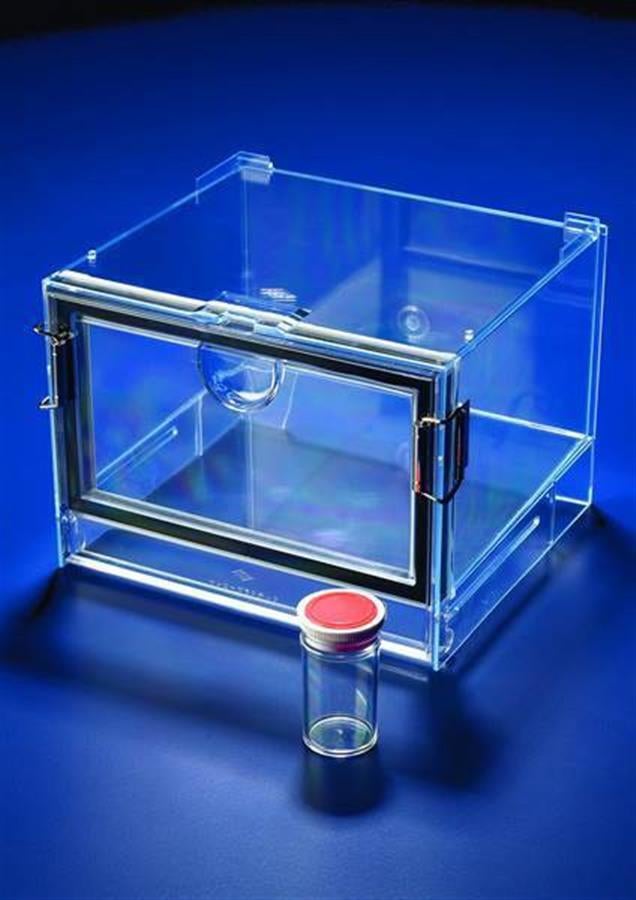
The Azlon? stacking desiccator cabinet provides moisture-free storage with an airtight door and is supplied with silica gel.Features:Provides moisture-proof storageClear high impact polystyrene cabinetSpace saving stacking featureAirtight door made from acrylonitrile-styrene with foam rubber gasketSupplied with sealed jar of silica gelDimensions:External L225 x W208 x H170mmInternal L190 x W175 x H110mmDoor Opening 188 x 110mm Cleaning, autoclaving and maintenance plasticware Azlon??plasticware is reusable but how long it lasts depends on how well you treat it! Follow these guidelines to keep your Azlon??plasticware in the best possible condition.
1. What chemicals are coming into contact with your plasticware?
Chemicals can adversely affect the performance of plasticware even resulting in damage. Make sure you use the most suitable polymer for the chemical. For example, if you are working with Acetone you should always choose LDPE over HDPE as products made of HDPE are likely to incur immediate damage. Why not consult the plastic technical guide if you are unsure.
2. How do you wash and clean your Azlon??plasticware?
Azlon??plasticware should be cleaned in warm water with Lipsol detergent and a soft cloth or sponge. To prevent scratching and ink removal, abrasive cleaners and scouring pads should be avoided. If you?re using an automatic laboratory washing machine, be sure to use temperatures below 60?C. This is especially important for volumetric plasticware as high temperatures can affect their accuracy.
3. Can Azlon??products be autoclaved?
A selection of Azlon??products are suitable for autoclaving. In general, if a product is made from polypropylene or PMP, it is suitable for autoclaving at 121?C or 135?C respectively. If you are still unsure then look at the 'A' symbol as all items that are autoclavable display a red Azlon??symbol next to them. When autoclaving plastic bottles care must be taken to ensure that the cap is completely loosened to prevent deformation of the bottle. Reattaching the cap before the bottle has sufficiently cooled will also cause deformation. We recommend completely removing the cap before autoclaving and attaching the cap to the side of the bottles with autoclave tape to keep track of the components.
We hope these guidelines help your Azlon??plasticware last longer and don?t forget to contact us if you have any questions!
Information has been? provided by DWK Ltd. Feefo Reviews Related Blogs A simple guide to desiccators
Desiccators are sealed containers that are used for drying samples under atmospheric pressure or vacuum pressure. These can also protect chemicals that are hygroscopic, as well as protect samples from dust and moisture in the air. Desiccators can be made of glass, polypropylene and polycarbonate, or acrylic in cabinet form. Below is a simple guide to desiccators.
Illustration of a desiccato...2 years ago How do I measure suspended solids? How is the gravimetric method different to other methods? The measurement of Suspended Solids is often required for discharge consent, and values may be reported to the Environment Agency (EA). Suspended solids give water a cloudy appearance There are several methods for testing the suspended solids present in a water sample, here we discuss the differences between the differen...8 years ago Nalgene Desiccator Cabinets - a larger way to preserve moisture sensitive items A Desiccator is a sealable enclosure containing desiccants used for preserving moisture sensitive items. They are used to protect chemicals which are hygroscopic or react with water from humidity. The most common desiccators in the laboratory are round and made of heavy glass which usually has a removable platform on which smaller items such as watch glasses or crucibles can be placed and st...11 years ago




![ANTI D TITRE – [Serum]](https://app.analysisafrica.com/backend/uploads/tests/images/1754385122_6891cae238432.jpg)



 No products in the cart.