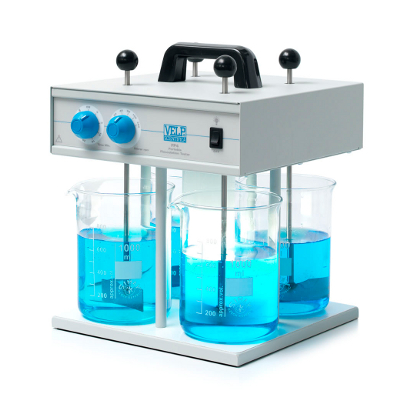
Description
PRODUCT DESCRIPTION
Portable flocculator that allows standard conditions to be adopted for jar test, that are the basic requirement for reproducible results.
Standardized Control
Choice of 20-40-50-100-200 rpm stirring speeds
Selectable operating time for unattended operation
Reliable and repeatable results from VELP stirring quality
Precise speed from an electronically controlled DC gear motor
On-Site
Designed to be used on-site for immediate results
Powered by dedicated battery or from car cigarette lighter
Practical Advantages
4 samples can be processed in parallel
Central light to facilitate reading
Stirring rods adjustable in height without tools
Robust Design
Strong resistance to chemical and mechanical corrosion
Anti-skid base for stability
GENERAL FEATURES
Construction material:
Epoxy painted metal structure
Disconnectable central light
Stainless steel stirring rods:
adjustable in height by a self blocking chuck
DC gear motor
Monoselector:
same speed for each rod
Number of stirring rods:
4
Power:
6 W
Power supply:
100 – 240 V / 50-60 Hz
Weight:
4,8 Kg (10.6 lb)
Dimensions (WxHxD) :
250x320x250 mm (9.8×12.6×9.8 in)
PERFORMANCE
Timer:
from 0 to 30 minutes (or continuous)
Electronic speed control:
20 – 40 – 50 – 100 – 200 rpm
Portable Floc Tester, On-Site Analysis
FP4 is a portable model, the ideal solution for on-site analysis. It can be powered by a battery or car cigarette lighter.
With 4 different positions, it is able to test different samples at the same time at a maximum speed of 200 rpm, whilst the possibility to switch on a central light simplifies the reading.
Height adjustment option for the stirring blades during operation and continuously variable speed (if desired) increase its capabilities.
In addition, the user can program the operating time for unattended operation. When time expires, stirring will be stopped automatically.
The carrying case, an optional accessory, is ideal for storing or transporting the unit.
What is JAR TESTING?
Jar testing is a pilot-scale test of the treatment chemicals used in a particular water plant.
In few words, it simulates the coagulation/flocculation process in a water treatment plant, helping the operator in the determination of the right amount of treatment chemicals, and, thus, in improving the
plant’s performance.
Jar testing entails adjusting the amount of chemicals and their sequence in which they are added. The sample requires to be stirred so that the formation, development, and settlement of floc can be watched just as it would be in the fullscale treatment plant.
The operator then performs a series of tests to compare the effects of different amounts of flocculation agents at different pH values to determine the right size floc.
Few operations are required for a correct test:
For each water sample, usually raw water, a number of beakers (jars) are filled with the same amounts of water sample
Each beaker is treated with different doses of chemical; other parameters may be altered besides dosage, including chemical types, mixing rate, aeration level/time, filtration type, etc.
Then, by comparing the final water quality in each beaker, the effect of the different treatment parameters can be determined and the best formula can be reproduced on large scale







![ANTI D TITRE – [Serum]](https://app.analysisafrica.com/backend/uploads/tests/images/1754385122_6891cae238432.jpg)






 No products in the cart.